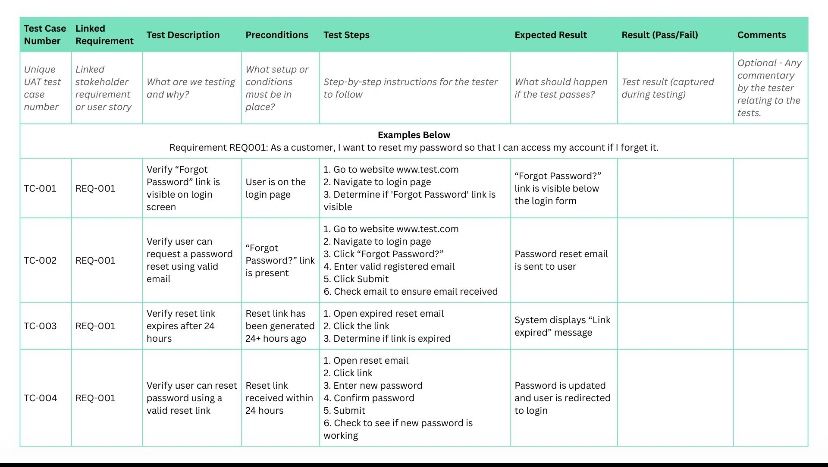
This post is how you can write your UAT test cases. This article is from the perspective of a Business Analyst (BA) that have been known to write many types of UAT.
To do that effectively, you need a structured approach to writing UAT test cases.
Here’s how I do it:
1️⃣ Start with the Requirement
→ Begin with a single requirement or user story.
→ Each requirement must be tested, and depending on how many acceptance criteria it has, you may need multiple test cases.
(Think: What is the business expecting from this requirement?)
2️⃣ Review the Acceptance Criteria
→ Acceptance criteria define the boundary of success for a requirement.
→ They help you understand what “good” looks like from the business’s perspective.
(Use these criteria as your guideposts for what to test)
3️⃣ Develop Test Cases Based on the Acceptance Criteria
→ Each acceptance criterion should translate into at least one test case.
→ Some may need both a positive (happy path) and negative (error or edge case) scenario.
(If a criterion says “User must receive a confirmation email,” test both a valid scenario and one where the email fails)
4️⃣ Complete the UAT Template for Each Test Case
→ For each test case, fill in these fields:
☑ Test Description – A clear statement of what’s being tested
e.g. “Test password reset email is triggered for valid email addresses”
☑ Preconditions – Any setup required before testing
e.g. “User is logged out and on the login page”
☑ Test Steps – Step-by-step actions for the tester to perform
e.g. Click “Forgot Password”, enter email, submit form
☑ Expected Result – What should happen if the system works correctly
e.g. “User receives reset email within 2 minutes”
(TIP: Keep the language business-friendly so anyone can run the test)
5️⃣ Repeat for Each Requirement
→ Once you’ve completed the test cases for one requirement, move to the next and repeat the process.
→ This ensures full coverage and traceability back to each business objective.
6️⃣ Review with Business Stakeholders
→ Once your test cases are drafted, share them with your business SMEs or stakeholders.
(This step is critical – their feedback confirms that you’re testing what really matters to them)
7️⃣ Prepare for Execution
→ After validation, the test cases are ready to be run.
→ Depending on your project, UAT may be carried out by business users, or you may help execute or facilitate it as a BA.

Leave a Reply